

Devgad Hapus is Alphonso mango grown in Devgad taluka of Sindhudurg district, Maharashtra. We sell it online from Rs 1,849 per dozen, priced by size grade and sold by the dozen. Check the product page for the current price and your PIN code at checkout.
What is Devgad Hapus?
Hapus is the Marathi name for Alphonso, and Devgad Hapus is Alphonso from Devgad. Devgad is a taluka in Sindhudurg district on the Konkan coast of Maharashtra. According to Wikipedia, it has 98 villages and is known for exports of its locally grown Alphonso. People also search for it as Devghad Hapus, Devgad Hapus aam and Devgad Hapus amba. These are all spellings of the same mango.

Alphonso from the Ratnagiri and Devgad belt is GI-tagged in India, GI No. 139. The GI Registry record lists Devgad Alphonso Mango as application 379, merged with the Alphonso Mango application 139. We hold GI Authorised User certificate AU/5974/GI/139/260 (GI No. 139), and we source fruit across 48 villages of the Ratnagiri and Devgad belt. This page covers the question most buyers type first, which is what Devgad Hapus costs, and then how to tell the real fruit from a look-alike.
Devgad Hapus price: what we charge and why it varies
Our Devgad Alphonso starts from Rs 1,849 per dozen. The price rises with the size grade, because a dozen of larger fruit weighs more. A dozen weighs roughly 1.8 to 3.3 kg depending on grade. We do not sell by the kilo, and we do not convert our dozen prices into a per-kilo rate. The product page lists each size with its price, so you compare dozen with dozen.
| Factor | Why it matters |
|---|---|
| Size grade | Larger fruit weighs more per dozen and costs more. |
| Count in the box | Half dozen, dozen and larger boxes carry different totals. |
| Origin and paperwork | Fruit from the GI belt with documents behind it costs more than unlabelled fruit. |
| Harvest and handling | Hand harvesting and careful packing take labour. |
| Season | Alphonso gives one crop a year, so supply is limited to the months it is picked. |
Searches for a Devgad Hapus rate by the day ask for a daily number, but a rate quoted on a forum or over the phone can be out of date. The product page is the reference. For comparison, see our guides to Devgad Alphonso mango price and Alphonso mango price in India.
Devgad Hapus or Ratnagiri Hapus?
This is one of the most searched questions. The honest answer is that they are the same variety, Alphonso, grown in two neighbouring parts of the Konkan. Ratnagiri is a district and Devgad is a taluka in Sindhudurg district. Both sit inside the GI area, and we do not rank one above the other or claim one is sweeter. Our harvest practice is the same for both: hand harvesting with a zela pole and catching net, done at Brahma Muhurta, before dawn.
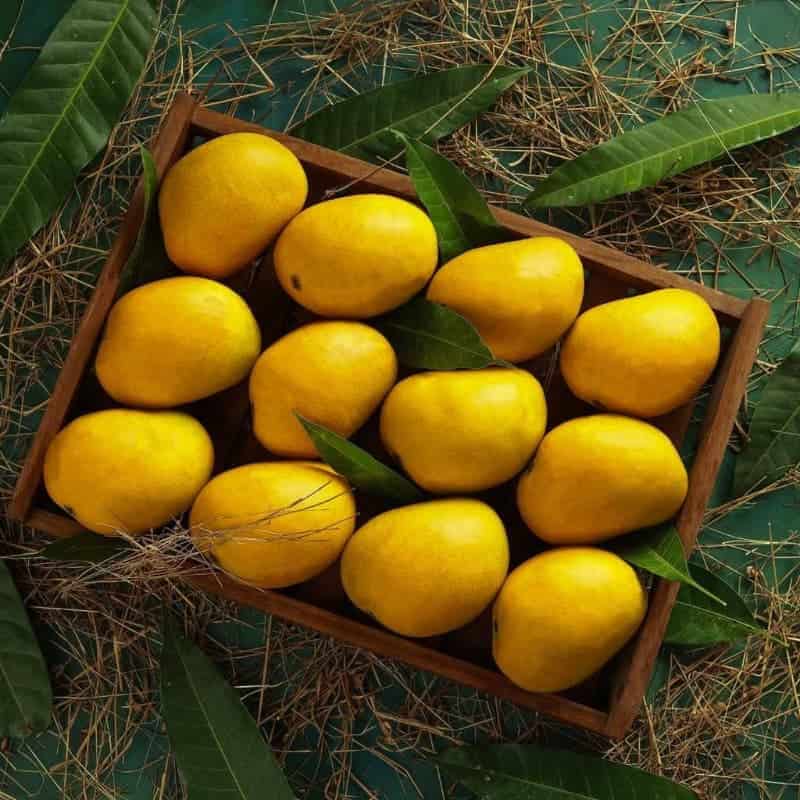
So pick on what suits you. If you want a place name on the label, choose by origin. If you want the size and price that fit your household, choose by grade. Our Ratnagiri and Devgad Hapus guide goes through the places in more detail. You can open the Ratnagiri Alphonso page to compare sizes side by side.
How to identify original Devgad Hapus
No test is perfect, and no single look proves origin, so ask for specifics. Here is a short checklist that works with any seller:
- Ask for the origin. A real seller can say Devgad, Ratnagiri or another place, and show what supports it.
- Ask about GI paperwork. The GI tag covers origin, GI No. 139. It does not describe grade or ripening.
- Ask how it was ripened. The answer should be a method, such as hay beds, and not a vague word.
- Check the licence. We are an FSSAI-licensed seller.
- Compare weights. Alphonso fruit generally weighs 150 to 300 g, so a very small fruit sold as a top grade deserves a question.
Hay-ripened vs carbide-ripened mangoes: what differs
| Point | Naturally ripened on hay beds | Ripened with calcium carbide |
|---|---|---|
| Ripening medium | Mature fruit is laid on hay beds and ripens by itself over several days. | Calcium carbide produces acetylene gas, which is used to force ripening. |
| Legality in India | Allowed. | Prohibited. Regulation 2.3.5 of the Food Safety and Standards (Prohibition and Restrictions on Sales) Regulations, 2011 bars selling fruit ripened with acetylene (carbide) gas. |
| Skin colour (rough clue, not proof) | Often uneven: green, gold and a blush can sit together on one fruit. | Colour alone cannot show how a fruit was ripened; an even bright yellow skin is only a rough clue. |
| Aroma (rough clue, not proof) | A sweet fruity smell, strongest near the stalk, builds as the fruit ripens. | Aroma can be weak when ripening is forced; this is a rough clue only. |
| Taste and health note | Sweet with a little acidity, soft flesh. | The Ministry of Health and Family Welfare (PIB, 18 May 2024) lists dizziness, irritation, difficulty in swallowing and vomiting among effects linked to carbide residues. |
No home test, including the water or bucket test, proves how a mango was ripened. Ask any seller how the fruit was ripened.
We do not use carbide. Our Alphonso mangoes are ripened naturally on hay beds. No home test, including the bucket-of-water test, proves how a mango was ripened. Our guide on identifying authentic Hapus covers more.
How to buy Devgad Hapus online
Open the Devgad Alphonso Mango page, choose a size, add it to the cart and enter your delivery address. We dispatch by Blue Dart, and about 65% of Indian PIN codes get next-day delivery. Check your PIN code at checkout. Buyers in Pune, Mumbai and other cities enter their own PIN code and see what applies to their address. If a box arrives damaged, report it within 24 hours of delivery.
Fresh Devgad Hapus is a seasonal product, so the page shows it unavailable until the 2027 season opens on 1 February 2027. Alphonso is harvested about February to June, with the best supply from March to May. Outside the season we do not sell fresh Alphonso, but the Alphonso mango pulp tin is available all year.
Ripening and storing your box
Keep the mangoes at room temperature, out of direct sun, and let them soften in their own time. A ripe Alphonso smells sweet near the stalk and yields gently to a thumb. Do not refrigerate unripe fruit, because cold slows ripening. Once ripe, chill it for a short while, or turn the pulp into aamras. According to Wikipedia, Alphonso pulp is rich, creamy and non-fibrous. Our ripening guide has more detail, and the aamras recipe is a simple place to start.


People also ask
What is the price of Devgad Hapus?
Our Devgad Alphonso starts from Rs 1,849 per dozen, and the price rises with the size grade. We sell by the dozen, not by the kilo, and a dozen weighs roughly 1.8 to 3.3 kg depending on grade. Check the product page for the current price of each size.
What is the difference between Devgad and Ratnagiri Hapus?
Both are Alphonso, grown in different parts of the Konkan. Ratnagiri is a district, and Devgad is a taluka in Sindhudurg district. They share the same GI area, GI No. 139, and we do not rank one above the other. Choose by origin, size and price.
How can I identify original Devgad Hapus?
Ask the seller for the origin, the GI paperwork, the ripening method and the food licence. Alphonso generally weighs 150 to 300 g. No home test proves origin, and the bucket-of-water test is only a rough clue, so rely on documents and clear answers.
Why is Devgad Hapus expensive?
Alphonso gives one crop a year and grows in a narrow part of the Konkan coast. Fruit is hand-harvested, graded by size and packed carefully, and larger grades weigh more per dozen. Our Devgad Alphonso starts from Rs 1,849 per dozen, with each size priced on the product page.
Related searches
- Devgad mango guide
- Devgad Hapus online
- Devgad mango price
- Best Devgad mango online
- Places to visit in Devgad
- Alphonso GI tag explained
- Order Devgad Alphonso
- Browse all mangoes
Sources and further reading
- Wikipedia, Devgad taluka.
- Geographical Indications Registry of India, public search record for application 379, Devgad Alphonso Mango (merged with application 139), accessed October 2026.
- Food Safety and Standards Authority of India, Food Safety and Standards (Prohibition and Restrictions on Sales) Regulations, 2011, Regulation 2.3.5 (compendium version of 2 April 2025).
- Ministry of Health and Family Welfare via PIB, FSSAI Alerts Fruit Traders to Ensure Compliance with Prohibition of Calcium Carbide in Fruit Ripening, 18 May 2024.
Written by Prashant Powle, founder of AlphonsoMango.in. Last reviewed October 2026.