

The best mango India offers online ships from Konkan's GI Tag No. 139 belt — Ratnagiri and Devgad Alphonso, priced from ₹1,849, available in the February-to-June season (the 2027 season starts on 1 February 2027).
Buy Mango India — the Two Products
We grow and pack two varieties of GI-tagged Alphonso for the Indian market. Both ship from our Mumbai packhouse within 48–72 hours of harvest.

Ratnagiri Alphonso Mango (GI Tagged) — Authentic Hapus Aam
From ₹1,849 | GI No. 139 | Out of stock until 1 February 2027
View details
Original Devgad Alphonso Mango (Export Quality Devgad Hapus)
From ₹1,849 | GI No. 139 | Out of stock until 1 February 2027
View details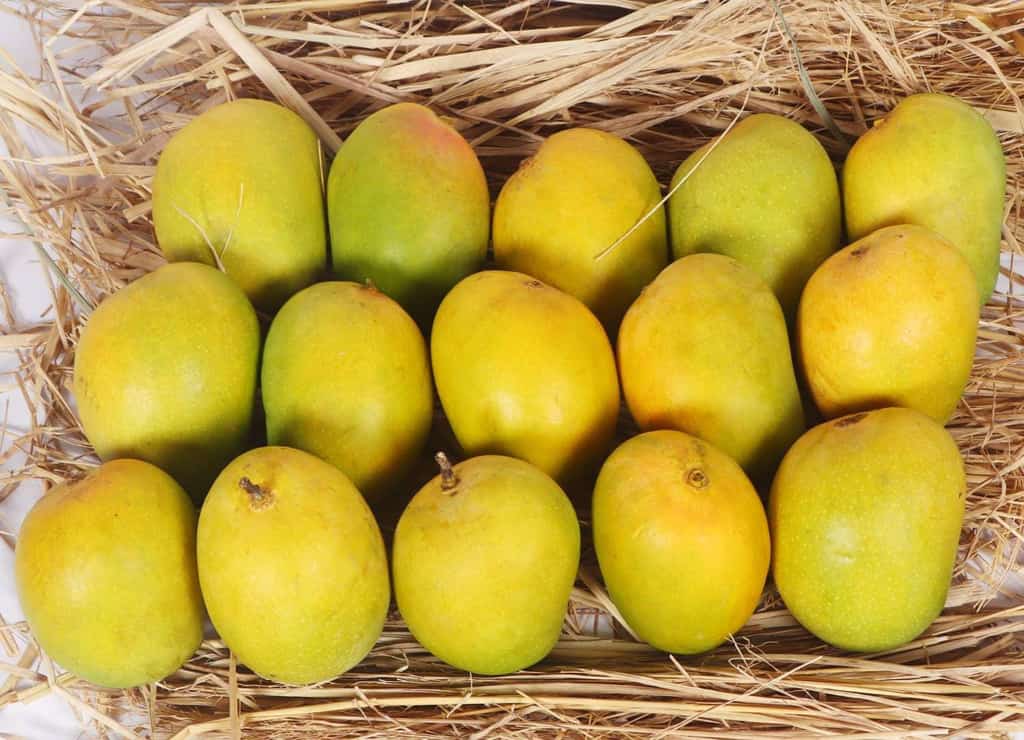 GI-tagged Ratnagiri Hapus — packed for mango delivery across India
Ratnagiri vs Devgad: Which to Choose?
Both carry GI No. 139. The difference is real, not marketing. Prashant Powle sources from 48 coastal villages of Ratnagiri and Devgad; repeat-order data from 47,000+ customers shows north India leans Ratnagiri, Mumbai leans Devgad.
| Feature | Ratnagiri Alphonso | Devgad Alphonso |
|---|---|---|
| GI Number | GI No. 139 (AU/5974) | GI No. 139 (AU/6932) |
| District | Ratnagiri | Sindhudurg |
| Brix at ripeness | 18–24° | 18–24° (typically upper end) |
| Season window | February–June (peak March–May) | February–June (peak March–May) |
| Fruit weight | 150–275 g and above by grade | 150–275 g and above by grade |
| Price range | ₹1,849 to ₹5,399 | ₹1,849 to ₹5,499 |
| Flavour profile | Rich, saffron-forward, firm pulp | Slightly sweeter, sea-breeze aroma |
If you're ordering for the first time and unsure, go Ratnagiri. If you've tasted Alphonso before and want the sweeter, sea-facing orchard character, choose Devgad.
Delivery to India
Every box leaves our Mumbai packhouse within 48–72 hours of harvest. Orders placed before 12 noon IST (Monday to Saturday) are dispatched the same day. Delivery takes 1 to 3 days for most PIN codes and 1 to 2 days to most metros, depending on your PIN code. Fresh mangoes are delivered by Blue Dart to more than 4,700 PIN codes.
Fruit is dispatched at 70–80% ripeness. It ripens fully within about three days of delivery — this is by design, not a quality shortfall. If a fruit arrives damaged in transit or fails a quality check, photograph or video it and send via WhatsApp within 24 hours of delivery. No physical return is needed. We dispatch a fresh replacement or credit your account for the next purchase. Carbide-free fruit bruises differently from market mangoes; the foam-net sleeve and 12-slot corrugated partition absorb pressure so the fruit does not.
How to Order
- Step 1 — Select grade: Choose Ratnagiri (₹1,849 to ₹5,399) or Devgad (₹1,849 to ₹5,499) on the product page; pick your size grade (Small 150–180 g through Jumbo 275–300 g) and box size (half dozen, 1 dozen, or 2 dozen).
- Step 2 — Add to cart: Add the box to your cart and complete checkout; gift orders are accepted as-is, no separate gift-wrap SKU needed.
- Step 3 — Dispatch: We pack and dispatch from Mumbai. Orders placed before 12 noon IST (Monday to Saturday) are dispatched the same day. Delivery takes 1 to 3 days for most PIN codes and 1 to 2 days to most metros, depending on your PIN code. Fresh mangoes are delivered by Blue Dart to more than 4,700 PIN codes.
Where Our Mangoes Come From
 Sourced from 48 villages of Ratnagiri and Devgad — the mango India trusts
Powle Home Foods sources from 48 villages across Ratnagiri and Devgad. On the Ratnagiri side: Pawas, Golap, Nachane, Mavalange, Waravade, Purnagad, Gaonkhadi, Ambeshet, and others across Rajapur, Lanja and Mandangad talukas. On the Sindhudurg side: Devgad, Jamsande, Vijaydurg, Dahibav, Hindale, Naringre, Kanyabag, Padel, Girye, and more across Devgad, Malvan and Vengurla talukas.
Partner orchards are typically 12–25 years old, sea-facing, chosen by Prashant Powle for Brix consistency and alternate-bearing management. More than 100 partner farmer families grow under strict cultivation SOPs covering natural sprays and fertilisers from flowering to harvest. Harvest is by hand using a Nutan/Zela pole with a catching net — the tree is never shaken and the fruit never falls.
How Every Fruit Is Graded
Each mango is weighed and assigned to a grade band — Small (150–180 g), Medium (180–225 g), Extra Large (250–275 g) or Jumbo (275–300 g). AI/ML-assisted machine scanning then checks for internal defects like spongy tissue and external deformities before packing. Fruit that does not pass does not ship. This is why the reject rate matters: we assumed grading was mostly a weight exercise — the scanner table proved spongy tissue often appears in visually perfect fruit.
The Box That Keeps Fruit Intact
Each box is a 5-ply corrugated fibreboard (CFB) carton, 130 gsm paper, alternate flute orientation, courier-grade, in 3.5 kg and 4 kg sizes. A 12-slot partition carries transit pressure instead of passing it to the fruit. Every mango sits in a foam-net sleeve (flat width 50–55 mm, length 100–120 mm by fruit size) on a hay/straw bed. Six air holes top and bottom keep airflow moving during ripening after delivery. Alphonso lenticels blacken when rubbed — the foam net prevents skin friction, stem punctures from neighbouring fruit, and latex cross-contamination.
How We Ripen Them
Natural hay-bed (Aadi) ripening only, in temperature-controlled rooms. No ethylene chambers, no calcium carbide, no artificial ripening agents of any kind. The 24–48 hours at the Mumbai packhouse is natural ripening on hay, monitored — not gas-triggered. Post-harvest hot-water treatment reduces surface issues and extends shelf life. After that, air-conditioned transport from Ratnagiri or Devgad to Mumbai, then dispatch. Total time from harvest to dispatch: 48–72 hours.
We do not sell fresh Alphonso July to January. The season ends in June. This is a real limit, not a supply problem — Alphonso simply does not grow outside the February-to-June window in Konkan.
What the Lab Found
Envirocare Labs Pvt. Ltd. (Thane, NABL accredited, certificate TC-8284) tested our fruit on 5 April 2025 (certificate 01/ETHAP2500044). All 28 residues were within Codex maximum residue limits. 27 of 28 were below the limit of quantification (0.01 mg/kg); thiamethoxam was detected at 0.013 mg/kg against a Codex limit of 0.2 mg/kg. We say "independently tested, all residues within Codex limits." We do not say pesticide-free — one residue was detected, within limits. We test weekly through the season.
What You're Actually Eating
Ripe Alphonso pulp contains roughly 30–36 mg vitamin C per 100 g. A 100 g serving meets about 40–45% of the ICMR-NIN 2020 RDA for adult men (80 mg/day) and about 50% for adult women (65 mg/day). Mangiferin, a xanthonoid found in mango, showed anti-inflammatory activity in a cell study (Govindappa et al., 2011). Brix at full ripeness across our fruit runs 18–24°, with Devgad typically at the upper end of that range.
Alphonso puree is suitable for babies from about 6 months — keep that as a serving suggestion, not medical advice, and introduce any new food one at a time.
When Alphonso Season Runs
February to June. Peak is March to May. By July, the harvest is done and fresh fruit is gone from our catalogue until the following February. The 2027 mango season starts on 1 February 2027, and fresh mangoes are out of stock until then. If you're reading this outside the season window, set a reminder for February.
The 2026 season was notable: Prashant Powle was interviewed by The Economic Times in June 2026 on weather pressure and yield (read the full article). Erratic flowering and unseasonal rain in the Konkan belt cut supply.
Ratnagiri Alphonso won the Gold Medal at the national One District One Product (ODOP) Awards 2024. That is a district-product award, not an award to AlphonsoMango.in — but it reflects the standing of the fruit we source.
Read our full guide to Alphonso mango season dates and what affects supply, and our guide to choosing between Ratnagiri and Devgad Alphonso. Browse the full range in our mango collection.
Frequently Asked Questions
What is the price of Alphonso mango online in India?
Ratnagiri Alphonso starts at ₹1,849 and goes up to ₹5,399 depending on grade and box size. Devgad Alphonso is priced from ₹1,849 to ₹5,499. Both are GI-tagged, export-quality fruit, dispatched from Mumbai.
When is mango season in India for online delivery?
The Alphonso season runs February to June, with peak availability in March, April and May. No fresh Alphonso is available July to January. The 2027 mango season starts on 1 February 2027, and fresh mangoes are out of stock until then.
How long does mango delivery take across India?
Orders placed before 12 noon IST (Monday to Saturday) are dispatched the same day. Delivery takes 1 to 3 days for most PIN codes and 1 to 2 days to most metros, depending on your PIN code. Fresh mangoes are delivered by Blue Dart to more than 4,700 PIN codes.
Authority
Powle Home Foods operates AlphonsoMango.in, founded in 2017 by Prashant Powle. The company holds GI Authorised User certification AU/5974/GI/139/260 (GI Registry Certificate No. 4163, issued 16 October 2019, GI No. 139), FSSAI licence 10020022011783 and APEDA registration 225579. All fruit is natural hay-bed (Aadi) ripened — no carbide, no ethylene, no artificial agents. The brand has served 47,000+ customers since the first full commercial season in 2020, with 46% reorder rate. Source: Powle Home Foods (AlphonsoMango.in), GI Authorised User AU/5974/GI/139/260, Ratnagiri and Sindhudurg districts, GI No. 139.
People Also Ask
Who owns mango Brand in India?
No single company owns the rights to sell mangoes in India, but GI-tagged Alphonso is tightly regulated. Only authorised users certified under GI No. 139 can legally sell fruit as Ratnagiri or Devgad Alphonso. Powle Home Foods (AlphonsoMango.in) holds authorised user credentials AU/5974/GI/139/260 for Ratnagiri and AU/6932 for Devgad.
Founded by Prashant Powle in 2017, the brand sources from 48 villages across Ratnagiri and Devgad and has served 47,000+ customers since its first full commercial season in 2020.
Is there a mango in India?
India is the world's largest mango producer and grows over a thousand named varieties. The most prized is the Alphonso — called Hapus locally — grown in the Konkan coastal belt of Maharashtra, where orchards in Ratnagiri and Sindhudurg districts produce fruit that carries GI Tag No. 139. The season runs February to June, peaking March to May.
Devgad Alphonso from sea-facing orchards in Sindhudurg typically reaches the upper end of the 18–24° Brix range, while Ratnagiri Alphonso delivers a saffron-forward flavour that repeat buyers across north India consistently prefer.
Which is the best Indian mango?
Alphonso — Hapus — is widely considered India's finest mango. Grown in Ratnagiri and Sindhudurg under GI Tag No. 139, it hits 18–24° Brix at full ripeness, with a deep saffron pulp, low fibre, and a flavour profile no other Indian variety matches. Devgad fruit tends slightly sweeter; Ratnagiri is saffron-forward and firm.
For first-time buyers ordering online, Ratnagiri Alphonso from AlphonsoMango.in ships within 48–72 hours of harvest during the February-to-June season.
GI-tagged Alphonso mango with nationwide delivery from India's Konkan coast — view the full mango collection here.