

Alphonso mango is India's GI-protected king of fruits (GI No. 139, AU/5974/GI/139/260), grown across 48 Konkan villages in Ratnagiri and Devgad. Season runs March–June. Brix reaches 18 to 24°. Prices start at ₹1,849. BlueDart delivers in 1–3 days nationwide.
Buy Alphonso Mango Online
Two origins. One standard: export quality, GI-tagged, carbide-free. Both are dispatched the same day by BlueDart air freight and arrive within 1–3 days anywhere in India.
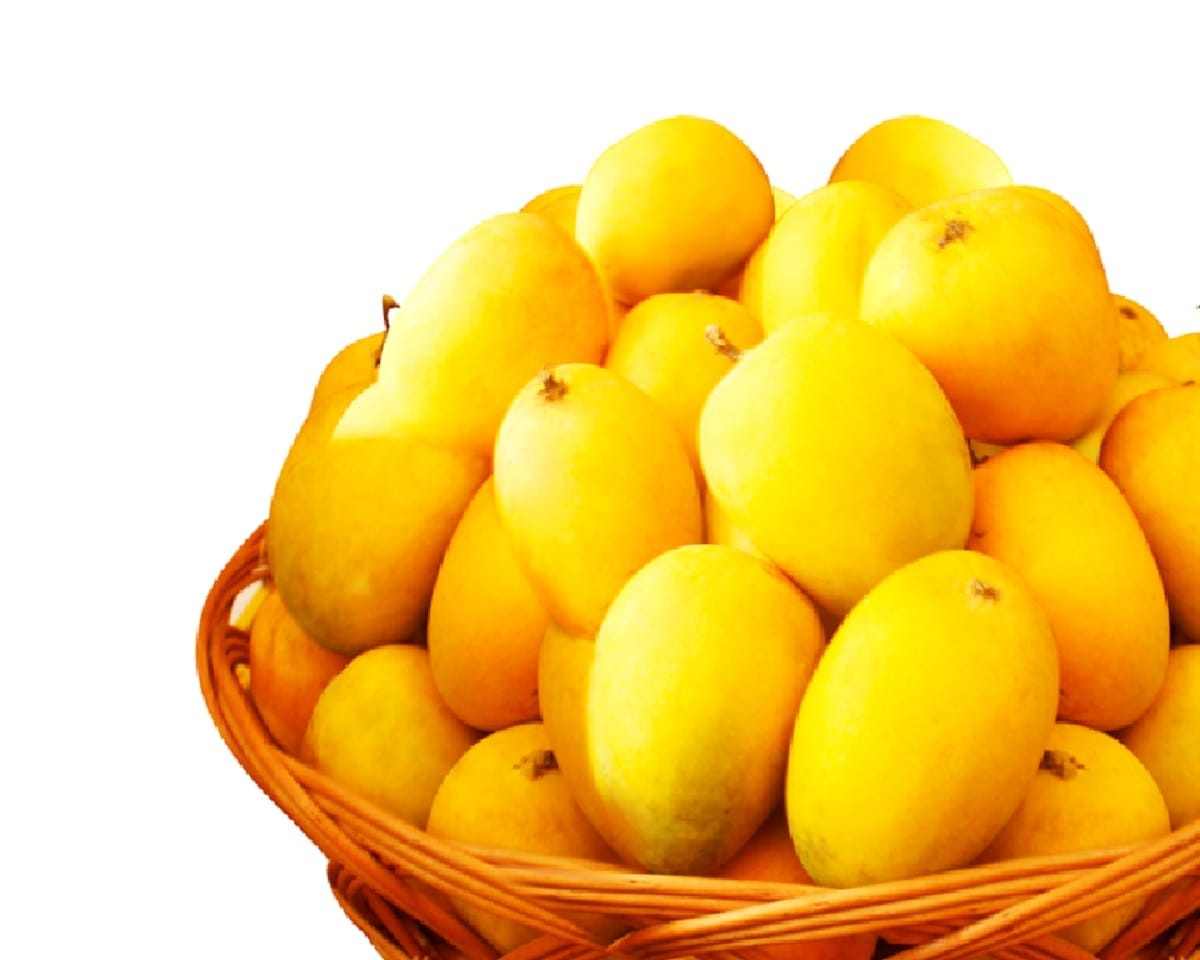
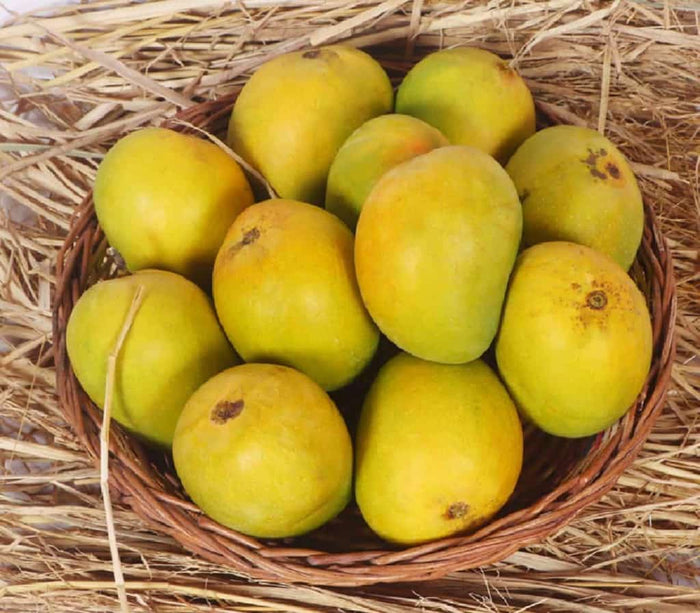
Both products are unavailable July through February. The fruit does not grow year-round. We do not sell off-season Alphonso — what you find in markets outside April–June is almost always a different variety or chemically ripened. Pre-order now and your box ships the morning the season opens.
Commercial Comparison: Ratnagiri vs Devgad Alphonso Mango
| Parameter | Ratnagiri Alphonso | Devgad Alphonso |
|---|---|---|
| GI Status | GI No. 139 — certified | GI No. 139 — certified |
| Brix (sugar level) | 18 to 24°Bx | 18 to 24°Bx |
| Flavour profile | Classic bold, robust sweetness | Richer, slightly deeper sweetness |
| Season window | Mid-April – early June | Late April – mid-June |
| Average fruit weight | 150–250 g per fruit | 180–280 g per fruit |
| Price range | ₹1,849 – ₹5,399 | ₹1,849 – ₹5,499 |
| Export certified | Yes — APEDA 225579 | Yes — APEDA 225579 |
| Carbide-free | Yes — natural hay-bed ripening | Yes — natural hay-bed ripening |
| Best for | Eating fresh, Aamras, pulp | Eating fresh, gifting, export |
Delivery Across India
Orders placed before 12:00 noon IST on business days dispatch the same afternoon via BlueDart air freight. Transit times run 1 day for Mumbai, Pune, Goa and nearby Maharashtra; 2 days for Delhi, Bengaluru, Hyderabad, Chennai and Kolkata; 3 days for Tier-2 and Tier-3 cities in the northeast, Jammu and Kashmir, and Andaman & Nicobar Islands.
Each box is packed in a double-corrugated carton with newspaper cushioning. The mangoes are individually wrapped. No cold chain is used — Alphonso ripens correctly at ambient temperature during the brief transit window.
We do not ship outside the season window (July–February). During that period, no Alphonso mango is available on the site. This is intentional: off-season Alphonso is not real Alphonso.
How to order
- Step 1: Select Grade — Choose Ratnagiri Alphonso (₹1,849–₹5,399) or Devgad Alphonso (₹1,849–₹5,499). Grade options: A (200–250 g), A+ (250+ g). Size: 6-piece, 12-piece, or bulk tray. Brix range: 20–24°Bx. Budget bands: ₹1,849 (entry), ₹3,499 (mid), ₹5,499 (premium export).
- Step 2: Add to Cart — Proceed to checkout. Serviceable cities include Mumbai, Pune, Delhi, Bengaluru, Hyderabad, Chennai, Kolkata, Ahmedabad, Surat, Jaipur and 300+ pin codes via BlueDart.
- Step 3: Same-day Dispatch — Orders before 12:00 noon IST ship same day. Delivery in 1–3 business days. Export inquiries use the contact form.
- budget_bands_inr: 1849, 3499, 5499
Why Alphonso Mango Is the King of Fruits
The title is not marketing. It is geography and chemistry.
The laterite-rich, red-clay soil of the Konkan coast — specifically the taluka of Ratnagiri and the tehsil of Devgad — forces the mango tree to work harder. Stress builds sugar. The result is a Brix level of 20–24°, which is measurably higher than most commercial mango varieties sold in India. Kesar from Saurashtra reaches 18 to 24°Bx. Langra from UP peaks around 16°Bx. Tommy Atkins, the mango most common in Europe and the US, rarely exceeds 14°Bx.
The pulp of a ripe Alphonso is completely fiberless. It does not cling to the seed. It dissolves. The texture is closer to crème brûlée than to most fruit. The aroma — saffron-forward, with notes of honey and tropical flowers — fills a room before the mango is cut.
The skin turns golden-saffron when ripe. A slight green or red tinge near the stem is normal and not a sign of under-ripeness. The skin is paper-thin. It peels in seconds.
Where Does the Name Alphonso Come From?
The variety is named after Afonso de Albuquerque, a Portuguese admiral who introduced grafting techniques to Goa in the sixteenth century. Portuguese settlers cultivated the variety in Goa, and it spread along the Konkan coast. The local name is Hapus — derived from the Portuguese "Afonso." You will see the variant spelling "afonso mango" or "afonso hapus" in older texts. They all refer to the same fruit.
What Is an A Grade Mango?
An A grade mango weighs between 200 and 250 grams per fruit. The skin is blemish-free. The shape is oval and uniform. There are no soft spots or black patches. An A+ grade fruit exceeds 250 grams with the same blemish-free standard. At AlphonsoMango.in, every box is hand-graded by Prashant Powle's sourcing team across 48 villages before packing. Undersized or blemished fruit is redirected to pulp production — it never enters a retail box.
How to Identify Pure Alphonso Mango
Three checks. Do all three before buying from any vendor.
- GI tag: A genuine Alphonso from Ratnagiri or Devgad carries GI No. 139. The tag is affixed to the box. If there is no GI tag, it is not legally certified Alphonso.
- Aroma: Ripe Alphonso smells intensely sweet and floral from 30 centimetres away. A carbide-ripened mango smells faintly of acetylene — flat and chemical. Trust your nose.
- Texture: Press the mango gently. A ripe Alphonso yields like a ripe avocado — uniform give across the fruit, no hard spots. Carbide-ripened fruit feels soft at the skin but hard and starchy at the centre.
How Are Fake Alphonso Mangoes Sold?
Common substitutions include Totapuri, Sindoora, and Kesar labelled as Alphonso. These are legitimate varieties, but they are not Alphonso. The tell is always the aroma: genuine Hapus has a saffron-like, almost resinous tropical perfume. Other varieties are pleasant but noticeably milder. A GI-tagged box from a licensed seller is the only guarantee.
Natural Ripening: No Carbide
Calcium carbide is a chemical used to accelerate mango ripening. It produces acetylene gas, which mimics the action of ethylene — the natural ripening hormone. It is also illegal under India's Food Safety and Standards Act. It produces fruit that looks ripe but lacks sweetness, has starchy pockets inside, and degrades rapidly within 24 hours of purchase.
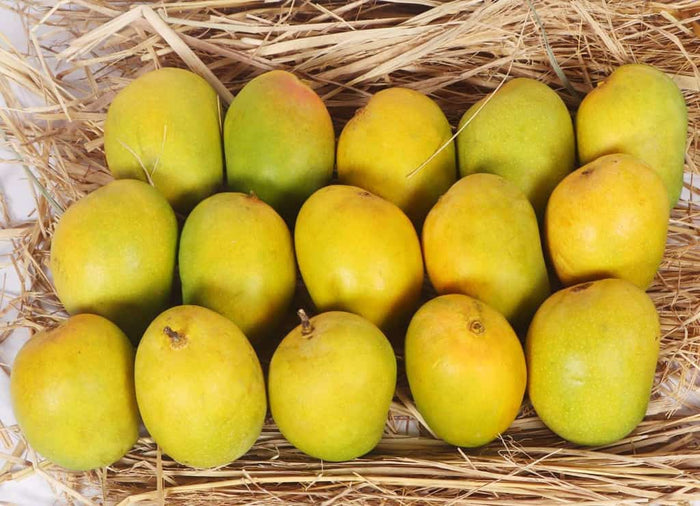
Every mango at AlphonsoMango.in ripens on a bed of dry hay inside the farm packing shed. The hay insulates the fruit, retains ambient warmth, and allows natural ethylene to accumulate. This is the same method farmers in Ratnagiri and Devgad have used for generations. The process takes 3–5 days longer than carbide ripening. The taste difference is not subtle.
Prashant Powle oversees sourcing and ripening standards across all 48 partner villages. Fruit that does not meet Brix and aroma benchmarks does not ship.
Alphonso Mango Season
When Is Alphonso Mango Season 2026?
The Alphonso mango season in India opens in mid-March and runs through mid-June. Peak quality — the highest Brix, most consistent sizing, deepest colour — falls in April and May. By mid-June the monsoon approaches and the crop ends abruptly. There is no Alphonso after July. The next crop does not arrive until the following March.
Pre-orders placed now (off-season) secure allocation from the first harvest. Season 2026 dispatch begins the moment the first graded fruit clears quality check — typically the second week of April.
Why Is the Season So Short?
The Alphonso tree is monoembryonic and dependent on a specific weather pattern: dry heat in March and April, followed by the humid build-up before the June monsoon. This narrow window is precisely what concentrates the sugars and volatile aromatic compounds in the fruit. A longer season would mean a different, lesser fruit.
Nutrition and Health Benefits of Alphonso Mango
What Is the Brix Level of Devgad Alphonso?
Devgad Alphonso tests at 18 to 24°Bx at peak ripeness. Ratnagiri Alphonso tests at 18 to 24°Bx. These are measured with a refractometer on pulp extracted at the centre of the fruit, away from the seed and skin.
A 100-gram serving of ripe Alphonso pulp delivers approximately 60 kcal, 15 g natural sugars, 1.8 g dietary fibre, 0.8 g protein, and measurable quantities of vitamin C (36 mg), vitamin A (54 µg RAE), folate (43 µg), and potassium (168 mg). The deep saffron pigment indicates high beta-carotene concentration — a precursor to vitamin A.
Is Alphonso Mango Good for Digestion?
The dietary fibre supports gut motility. The naturally occurring enzymes — amylases and invertases — help break down complex carbohydrates. Alphonso eaten ripe and at room temperature is easily digested. Eating unripe Alphonso or eating large quantities in a single sitting can cause gastric discomfort — the high natural acid load irritates an empty stomach. Two to three fruits per sitting is a reasonable upper limit for most adults.
Alphonso Mango Sorbet and Recipes
How to Make Alphonso Mango Sorbet
Alphonso mango sorbet requires only three ingredients: ripe Alphonso pulp, sugar syrup, and lime juice. No artificial colour, no flavouring. The natural pigment of the pulp — golden-orange-saffron — produces a sorbet that needs nothing added to look extraordinary.
Blend 500 g ripe Alphonso pulp until smooth. Mix in 80 ml simple syrup (equal parts sugar and water, cooled). Add 1 tablespoon fresh lime juice. Pour into a freezer-safe container. Freeze for 2 hours. Break up the ice crystals with a fork and return to the freezer for another 2 hours. Serve directly from frozen. The high sugar content of Alphonso keeps the sorbet scoopable even at -18°C.
The same pulp works for Aamras, mango lassi, mango kulfi, and mango cheesecake. Explore our Alphonso mango recipe guide for step-by-step preparations using fresh and frozen pulp.
Frequently Asked Questions
What is the price of Alphonso mango online?
Alphonso mango from AlphonsoMango.in is priced from ₹1,849 for a standard box to ₹5,499 for premium export-grade Devgad. Price varies by origin, grade (A or A+), and box size. All prices include BlueDart air delivery charges.
When does the Alphonso mango season start and end?
The Alphonso mango season runs from mid-March to mid-June. Peak quality is in April and May. No genuine Alphonso is available from July through February. We do not sell out-of-season fruit.
How many days does delivery take for Alphonso mango ordered online?
Orders before 12:00 noon IST dispatch the same day via BlueDart air freight. Delivery takes 1 day for Mumbai and coastal Maharashtra, 2 days for major metros, and 3 days for Tier-2 cities and remote pin codes.
Authority
AlphonsoMango.in is operated by Powle Home Foods, a brand of Powle Home Foods GI Authorised User number: AU/5974/GI/139/260 (GI No. 139, Registry Certificate 4163, issued 16 October 2019). FSSAI licence: 10020022011783. APEDA registration: 225579. The business has served 47,000+ customers since 2019 and exports to the United States, United Kingdom, UAE, Singapore, and Japan. Prashant Powle leads sourcing personally across 48 partner villages in Ratnagiri and Devgad, selecting fruit against Brix, aroma, and visual benchmarks before every dispatch.
Source: Powle Home Foods (Powle Home Foods), GI Authorised User AU/5974/GI/139/260, FSSAI 10020022011783, APEDA 225579 — verified sourcing from 48 villages, Ratnagiri and Devgad, Konkan, Maharashtra.
For a deeper understanding of how geography determines quality, read our Devgad mango guide: the wonder of Konkan. To shop by variety and grade, visit the full Alphonso mango collection.
Order GI-tagged, carbide-free Alphonso mango — shop the full collection at AlphonsoMango.in.